
Get the latest news to your email inbox FREE!

REGISTER

Get the latest news to your email inbox FREE!

REGISTER
HomeRuralDon’t panic about grubs in chickpeas

Don’t panic about grubs in chickpeas

Have been hearing about significant Helicoverpa larvae numbers being present in our current chickpea crops throughout the state.

With temperatures starting to reach an average daily temperature of over 15 degrees, true flowers on our chickpea plants will begin to form, followed by pod set and the start of seed filling.

With these stats in mind, what are these Helicoverpa larvae eating in our chickpea crops prior to these temperature thresholds, during the sterile flowering stages?

Mostly, they are consuming leaves or foliage, not necessarily flowers, and definitely not pods at this stage.

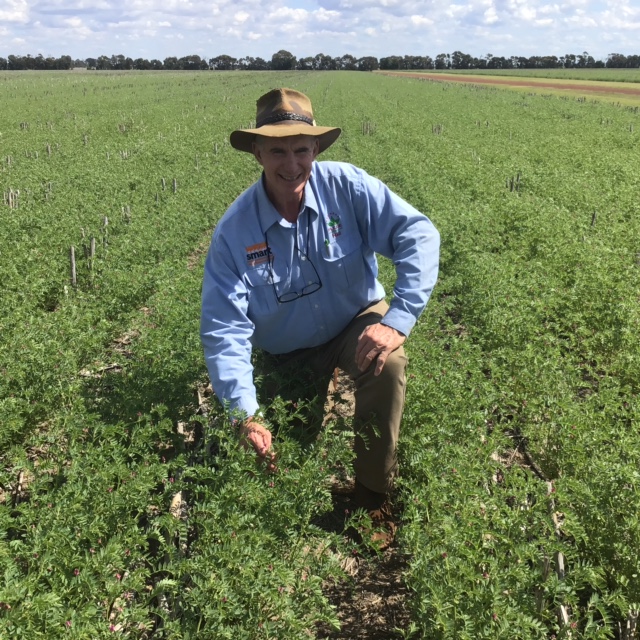
My own experience in chickpeas at this stage suggests that quite high numbers of Helicoverpa larvae can be tolerated.

By high numbers, I am referring to up to ten larvae per square metre.

Without knowledge or experience, you could end up spraying your chickpea crop quite a few times if you simply use the basic grub or larvae threshold throughout the vegetative stages and beyond.

I proffer this advice to you all based on my years in the paddock, backed up by solid research done by DPI entomology staff some years ago.

It is also a chance to get off the bandwagon of overapplying conventional insecticides to our seasonal Helicoverpa population.

Now, I don’t mind applying some lower rates of Vivus Max, our premier biological insecticide with NPV (nucleopolyhedrovirus), during the vegetative stages and even into the early flowering stages of our favourite winter pulse crop, especially when lots of larvae are present.

There are plenty of advantages to this early NPV application practice, such as reducing the potential for insecticide resistance to develop in our top-tier insecticides like Chlorantraniliprole, Emamectin, Methoxyfenozide (Jemvelva), and even the slightly older product, Indoxacarb.

By using this biological product, Vivus Max, in our vegetative or early flowering stages, when larvae are actively foraging, there is a good chance this particular crop will only require a single insecticide application.

That’s a good result all round, and it certainly eases the pressure on rising insecticide resistance levels and the risk of breaching any insecticide withholding periods.

Plus, it helps avoid the need for late ground rig applications, which can knock off pods and squash important yield-bearing branches.


Digital Edition
Subscribe

Get an all ACCESS PASS to the News and your Digital Edition with an online subscription

Net zero is nonsense

When the Federal Government announced its net zero plan last year it said that it wanted to deliver 119 million tonnes of carbon reductions...
More News

Cotton picking begins in the highlands

Cotton picking kicked off in central Queensland last week with Emerald growers Denis and Aaron Kiely, who began picking their 71-hectare cotton crop on...

Coalition touts era of trust and unity after split

Liberal and National leaders insist they trust each other, guaranteeing no further Coalition break-ups after striking a deal to end the parties' second split...

Roblox on notice over ongoing child grooming concerns

Australia's eSafety notified Roblox last week of its intention to directly test the platform’s implementation and effectiveness of the nine safety commitments it made...

Stanthorpe Festival – crushing for 60 years

Queensland’s Granite Belt comes alive this month for the long-running Stanthorpe Apple and Grape Harvest Festival - a celebration of food, wine and community. The...

Flood recovery, tick risk, and staying ready

I’m pleased to inform you of some good news after the recent devastating floods through our state’s north-west. Many cattle producers across Queensland are...

Grants to power first-nations-led climate solutions in rural Australia

First Nations-led and First Nations-directed organisations in remote, rural and regional communities across Australia are encouraged to apply for grants of up to $20,000...

A problem caterpillar in legume crops

This week is a big wake-up call to our many mungbean growers and agronomists in the Northern Region, with this attached larvae or grub...

Tougher Queensland laws on antisemitism and terrorism to be introduced

Tougher laws - to be introduced in Parliament this week - will deliver a suite of changes focused on antisemitism, terrorist symbols and phrases,...

Idol singers putting Longreach on the map

Longreach has already featured on the current season of Australian Idol, with local entertainer Art Cooper’s audition airing on Monday, 2 February, while two...

Flying fox dispersal starts in Duaringa

The Central Highlands council began a planned week-long flying fox dispersal in Duaringa on Friday, 6 February, as part of ongoing efforts to manage...